100 Culinary Icons Set: A Practical Design Resource for Food Brands
Every food business, recipe blog, or hospitality brand eventually needs visuals that communicate instantly. Text alone rarely conveys the warmth of a freshly baked croissant or the precision of a chef's knife. That is where a focused, well-executed icon set becomes invaluable. The 100 Culinary Icons Set delivers exactly that—a curated library of food and drink symbols designed to save time, maintain consistency, and elevate visual communication across projects.
Visual Style and Personality of the Icon Set
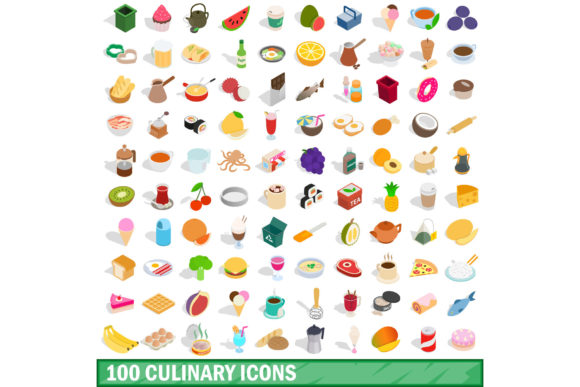
Looking through the 100 Culinary Icons Set, the first thing you notice is the deliberate restraint. These are not overly whimsical illustrations or hyper-realistic renderings. They sit in a sweet spot between clarity and character. Each icon follows a consistent stroke weight, so nothing feels heavier or lighter next to something else. That matters more than most people realize: when icons look like they belong to different families, the entire design feels amateurish.
The style leans modern but not cold. Clean lines define the silhouettes, yet there is enough detail to distinguish a whisk from a spatula or a cocktail glass from a wine glass. The set covers obvious essentials—forks, knives, spoons, cups—but also includes niche items like a mandoline slicer, a pastry brush, and a mortar and pestle. For a chef launching a product line or a blogger building a recipe index, that breadth means fewer trips back to the drawing board.
Color is handled thoughtfully. The icons work well in monochrome, which is critical for print projects where budget limits color usage. But they also take fills and accents naturally. If your brand palette leans warm terracotta and cream, or cool slate and white, the shapes adapt without fighting the surrounding typography. That versatility makes the set feel like a design asset rather than a design constraint.
Where the Icon Set Shines Across Projects
I have worked on enough brand guidelines to know that consistency is what separates polished projects from scrappy ones. The 100 Culinary Icons Set brings that consistency out of the box. For a restaurant group developing a website, menu, and social presence, using the same icon family across all touchpoints builds recognition fast. A visitor sees the same knife-and-fork mark on the homepage header, the reservation confirmation email, and the takeout packaging. That repetition signals professionalism.
I see three categories where this set delivers the most value:
- Digital products: Recipe apps, food delivery platforms, and meal-planning websites need navigation icons that users parse instantly. A small icon of a frying pan next to the "skillet meals" category beats reading text. The set's consistent proportions mean you can scale them down for mobile without losing legibility.
- Print and packaging: Brochures, product labels, and in-store signage benefit from the set's clean output. I have seen these used on spice jar labels where space is tight—a small chili icon next to the heat level indicator communicates faster than a paragraph. The monochrome-friendly design also keeps printing costs predictable.
- Editorial and publishing: Cookbooks, food magazines, and newsletters can use the icons as section dividers, bullet points, or margin accents. Even a simple list of ingredients feels more engaging when each item has a small icon beside it. Readers scan faster, and the page layout breathes better.
Influencing Readability, Hierarchy, and Brand Perception
Icons do more than decorate—they guide the eye. In a crowded recipe layout, a small knife icon next to "Prep Time" and a thermometer icon next to "Cook Temp" creates an instant visual hierarchy. Users do not need to read every label to understand the flow. The 100 Culinary Icons Set supports this kind of information design because the icons are distinct enough to tell apart at a glance. A measuring cup and a mixing bowl look different even at small sizes, which is not always true of overly simplified sets.
From a brand perception standpoint, using a unified icon library signals that you care about details. A coffee shop menu with hand-drawn icons that vary in weight feels charming for about five seconds, then confusing. A menu using this set reads as intentional and trustworthy. That might sound like a small thing, but in food and hospitality, trust is currency. Customers who perceive consistency in your visual materials are more likely to trust your food safety, your sourcing, and your customer service.
For entrepreneurs building a brand from scratch, this set removes a common bottleneck. Instead of hiring an illustrator for every new icon need, you drop in a ready-made graphic that meets the same standard. That speeds up production without sacrificing quality. And because the icons are vector-based, scaling them from a tiny web favicon to a large banner print introduces no distortion.
Practical Guidance for Choosing and Using the Set
Before you purchase any design asset, it pays to evaluate how it fits your actual workflow. Here is a practical checklist based on my own experience evaluating icon sets for client projects:
- Audit your content: List every place you currently use icons or plan to use them. Recipe pages, category headers, social media templates, email footers, signage. Then cross-check against the included icons in the 100 Culinary Icons Set. Does it cover your most-used items? For example, if your brand focuses on baking, make sure pastry-specific icons (rolling pin, piping bag, cooling rack) are present before you commit.
- Test a pairing: Pull a few icons into your design software alongside your primary typeface. If your brand uses a clean sans serif font like Work Sans or Inter, the icons will likely sit well. If you lean toward a more expressive display font or a script font for headings, check that the icon weight does not overpower the text. Good font pairing principles apply here—balance contrast with harmony.
- Review the licensing: Commercial licensing varies between design asset sellers. If you are a small business owner or a marketer creating assets for clients, confirm that the license covers your use case. The 100 Culinary Icons Set typically includes commercial rights, but verifying ahead of time avoids headaches down the road.
- Plan for scalability: Because these icons work well in both color and monochrome, decide early where you will use color versions and where you will keep them black or white. For example, a dark-mode website might use white icons on a dark background, while a printed takeout menu uses a single accent color. Testing both scenarios early prevents rework.
Practical Examples from Real Projects
Consider a small-batch hot sauce company building their first website. They need category icons for each flavor profile—smoky, fruity, spicy, tangy. A set of generic icons would help, but the 100 Culinary Icons Set includes specific symbols like a chili pepper, a citrus slice, a smoke wisp, and a drop of sauce. That specificity lets the brand communicate flavor notes visually without relying on text alone. On the product detail page, a small icon next to ingredients speeds up scanning. The result feels more polished than a DIY solution and more cost-effective than custom illustration.
Another scenario: a food blogger publishing a year-end roundup of best recipes. Using the set's icons as dividers between sections—appetizers, mains, desserts, drinks—creates a clean, magazine-like layout. Readers scroll faster and linger longer because the visual breaks reduce fatigue. And because the icons are consistent, the blog's brand identity strengthens with every post.
For a subscription meal kit service, icons become functional tools. Each ingredient package could include a small icon showing whether it needs refrigeration, freezing, or pantry storage. The 100 Culinary Icons Set includes enough kitchen and storage symbols that a system like this works without reinventing the wheel. Customers learn the visual language quickly, and operational teams spend less time explaining.
Final Observations on Value and Fit
The best design assets are the ones you stop noticing because they work exactly as needed. The 100 Culinary Icons Set achieves that by staying focused on food and drink applications while maintaining the visual discipline of modern typography. It does not try to be everything to everyone. Instead, it serves a specific audience—designers, marketers, publishers, and entrepreneurs working in food—and serves them well.
If you are building a food brand, a cooking app, a restaurant website, or any project where culinary visuals matter, this set deserves a place in your design assets folder. It saves time, brings consistency, and lets you focus on what actually matters: the food, the story, and the people you are serving.